
Conference Emcee & DJ Services
A conference is a schedule with people inside it. We run the music and the microphone across the whole program, from registration through the closing session, so every transition lands on time and each room arrives ready to be there.


- Experienced with corporate conferences & executive summits
- Polished DJ services for formal networking events
- Seamless support for presentations, panels, and receptions
Conference Emcee Services
Most conference bookings start as a DJ request and end up needing an emcee too, because someone has to open the room, introduce speakers, and cover the gaps a run of show never fully accounts for. We do both from one position. At the Diversity Alliance for Science East Coast Conference at the Marriott Newark Airport, 2025 and 2026, that meant hosting keynote transitions, workshops, breakout sessions and evening receptions for roughly 300 life sciences leaders, with the music curation shifting register between session time and networking time. When the venue’s own wireless microphone failed mid-program, our backup mic was already on our own mixer, so the swap happened without the room ever losing the thread. That is the emcee role and the DJ role solving the same problem from the same chair. See our corporate event emcee services for the full case study format.
Why a Conference Needs a Different Kind of DJ
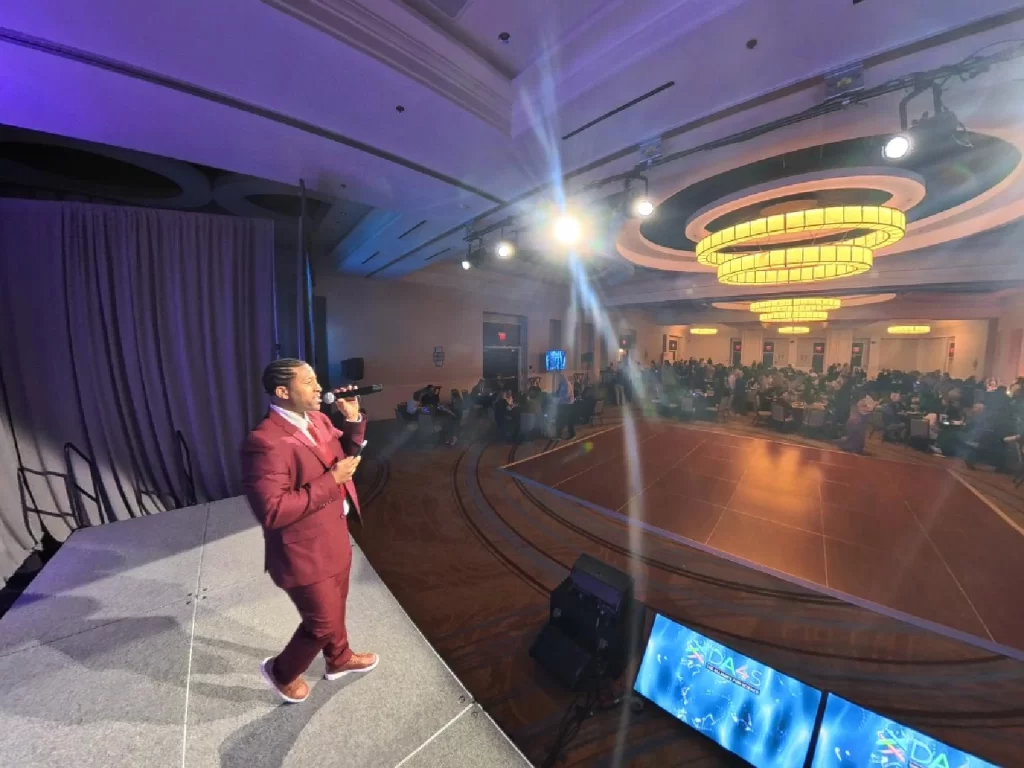
Corporate conferences and summits are high stakes. Attendees expect an organized, professional environment where transitions are smooth and energy levels are carefully managed. Our Conference & Summit DJ Services handle every detail from walk-in music and session start cues to networking breaks and evening receptions; ensuring your audience stays focused and engaged.
Unlike entertainment focused DJs, we specialize in executive environments, balancing formality with energy where appropriate.
What we Handle on Site
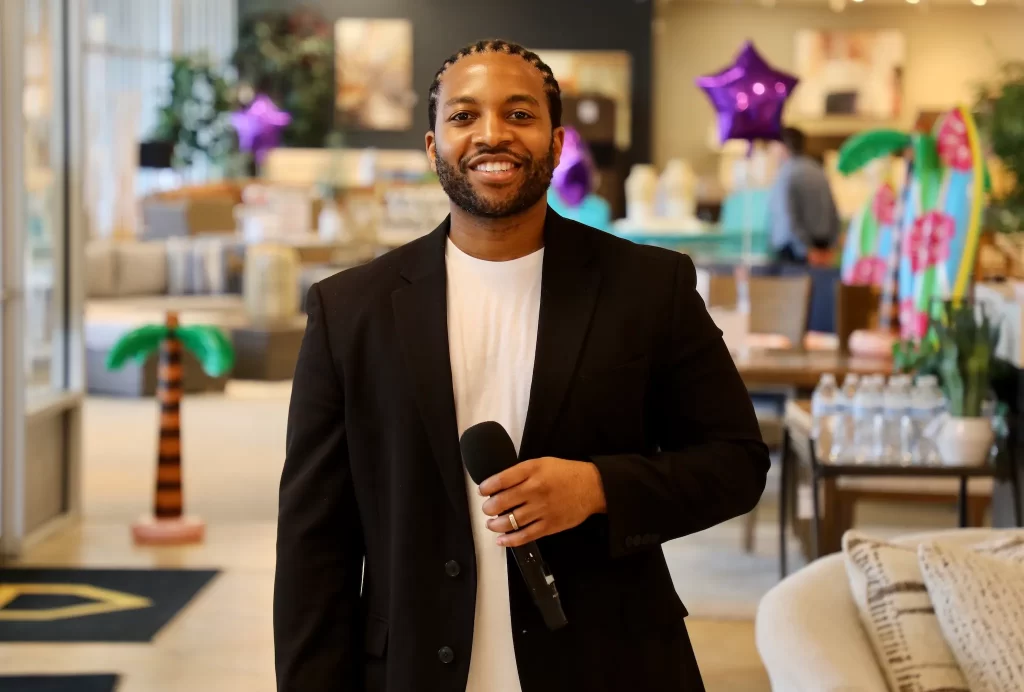
- Tailored music for session transitions and networking periods
- Microphone and audio management for speakers and moderators
- Coordination with AV teams to ensure perfect timing
- Flexibility to match audience energy without disrupting focus
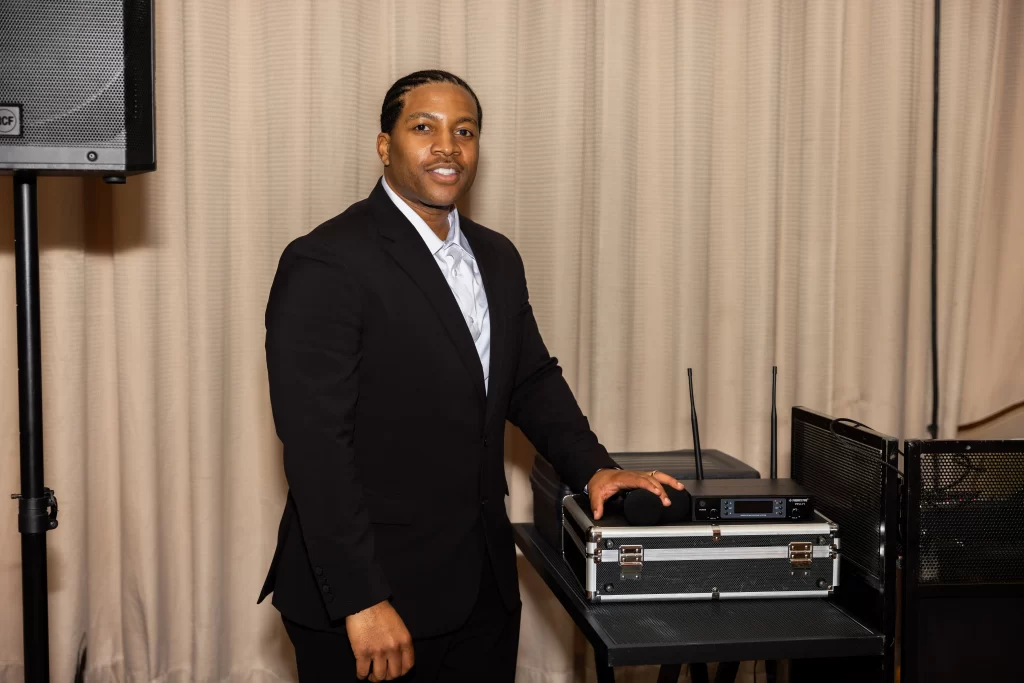
- Backup equipment for zero technical risk
Events we Work
- Strategy conferences and leadership summits
- Industry conferences and trade shows
- Executive workshops and panel discussions
- Networking events and gala style receptions within conferences
- Professional summits requiring seamless audio execution
Keeping Every Session on Schedule
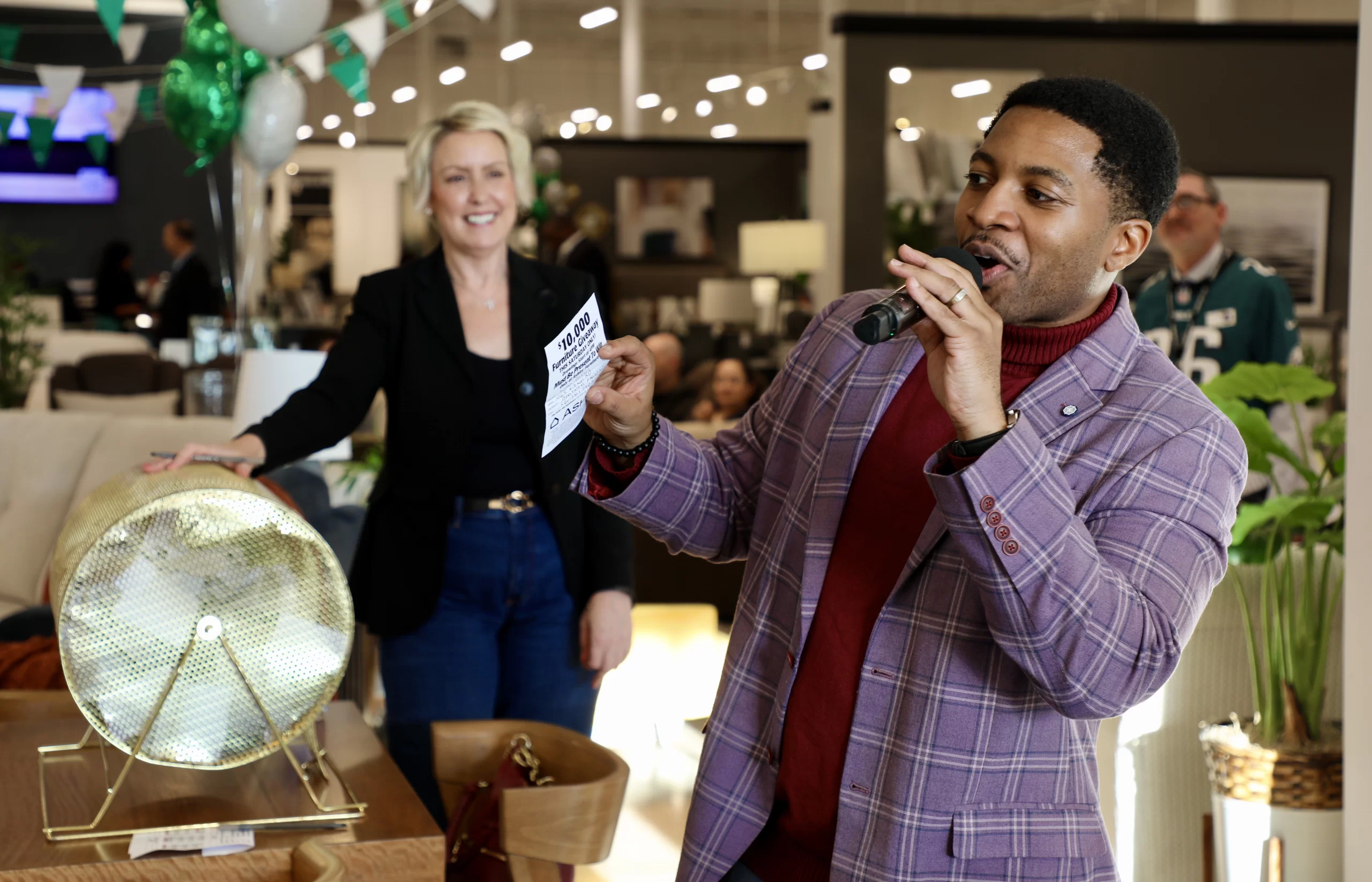
Registration & Arrival: Professional background music to set a welcoming tone
Keynote & Panel Sessions: Flawless audio cueing for presenters and moderators
Networking & Breaks: Curated music to maintain energy without distraction
Evening Receptions: Optional elevated energy for informal networking or celebrations
How we Show Up
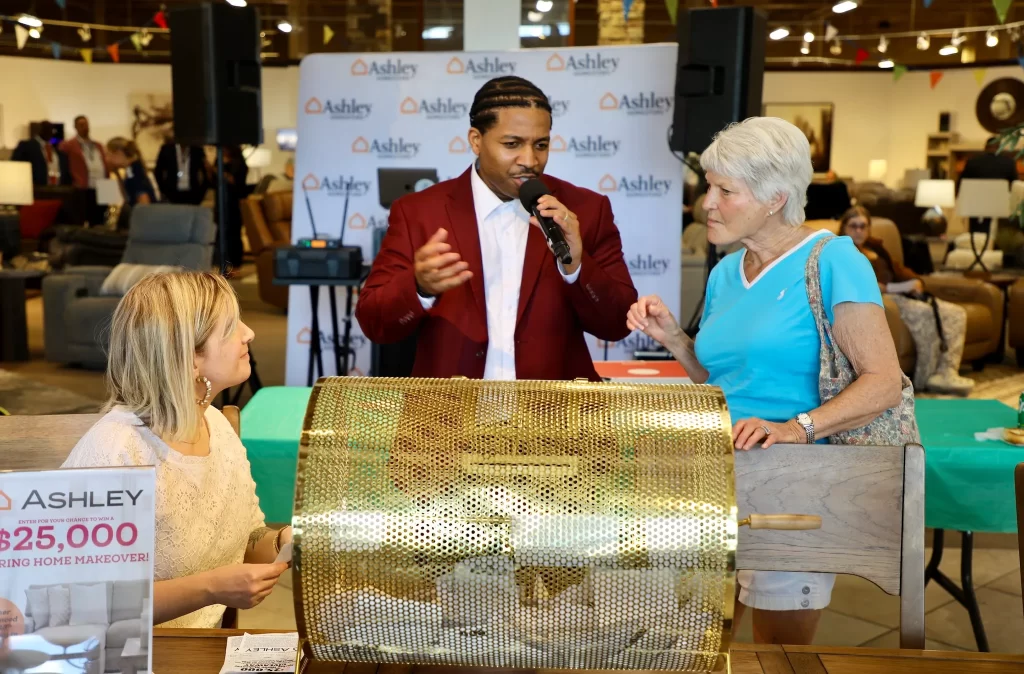
- Corporate appropriate attire for professional appearances
- Early setup and coordination with production teams
- Full insurance and contingency planning
- Experience across large scale, executive level conferences
Book Your Conference Entertainment
Professional music and audio management can make or break an executive event. Ensure your conference runs flawlessly.
Need a host or DJ for your convention? See our convention emcee and DJ services, with case studies from 500 person general sessions.
Built for Multi Day Programs
A conference DJ has to support a multi day program where general sessions, breakouts, sponsor activations, and evening receptions all run on a single timeline. As a conference DJ, we deliver clean transitions between content blocks, walk on music for keynotes, energetic open music for breaks, and a polished close for evening receptions. Every cue ties back to your event objective.
Keynote Walk Ons and General Sessions
Keynote moments set the tone for the entire summit. Our conference sets include custom walk on tracks for executive speakers, branded sound design between sessions, and rehearsed timing with your AV team so handoffs are seamless. The audience never feels the seam between content and entertainment.
Sponsor Activations and Breakout Areas
Sponsor activations need energy without overwhelming nearby breakout rooms. Our conference sets balance volume, curate brand safe playlists, and add custom intro loops so sponsors get the spotlight without disrupting concurrent sessions. Every dollar of sponsorship spend gets a return in the room.
Welcome Receptions and Closing Parties
Welcome receptions and closing parties are where conferences earn their best reviews. Our sets build the energy curve from arrival, through the program, into the dance floor, and protect every speaker moment along the way. Attendees leave talking about the experience, not just the content.
AV Coordination and Production Partnership
Our conference work includes full AV coordination. We work alongside your production company, video team, and venue lead to lock in power, sound, lighting, and timing well before doors open. Backup systems are in place for every session so technical risk is removed from your run of show.
This work requires an understanding of conference culture that goes beyond typical event entertainment. DJ Reese is a member of the Meeting Professionals International Greater New York Chapter, which is where the planners who run these programs actually meet. Both MPI and PCMA treat event music as part of the program rather than decoration around it, because it has to support speaker content, networking moments, and the overall conference narrative.
No Stress Zone Entertainment’s conference services are purpose-built for the demands of conference and summit environments. That work includes pre-event music curation, real-time audio management during speaker transitions, and high-energy set designs for networking sessions and closing ceremonies.
Planning Your Event: What to Expect
Booking a conference DJ is a different process than booking entertainment for a social event. Conference environments come with unique constraints — fixed speaker schedules, breakout room acoustics, AV system handoffs, and an audience that spans multiple departments, seniority levels, and sometimes time zones. Our sets are designed to work within those constraints, not around them.
The planning process starts with a detailed intake conversation covering your run of show, AV setup, room layout, and audience demographics. We coordinate directly with your AV team and event production staff so that music transitions, microphone handoffs, and speaker introductions are seamless. Nothing is improvised on-site that should have been planned in advance.
One Conference in Detail: Alliance for Science
The Alliance for Science, known as the Diversity Alliance for Science until it rebranded in 2026, runs its Annual East Coast Conference at the Marriott Newark Airport Hotel in New Jersey. Eighteen years running, invitation only, and around 300 in the room: pharmaceutical executives, CEOs of scientific and clinical enterprises, life sciences suppliers and the buyers they came to reach. We hosted the 2025 conference under the Diversity Alliance for Science name and we are back for the 2026 East Coast Conference under the new one.
What the room was like
They arrived ready. This was not a flat room that needed lifting, it was a room already full of energy, and that is a different problem. The job there is aiming the energy at the agenda instead of letting it drain into the hallway before the first session starts.
What went wrong, and what it looked like from the floor
The AV company’s microphone stopped working mid-program. We carry our own wireless mic. We hooked ours into the system and kept going. No dead air, no apology from the stage, no gap in the program. Most of the room never knew anything had failed.
That is the entire argument for hiring somebody who has done this before. Equipment fails at conferences, and it does not ask when. What a planner is actually buying is the eight seconds between the failure and the fix, and whether their audience ever finds out it happened.
What the role covered across both years
Emcee across keynote transitions, workshops, breakout sessions and evening receptions. Music curation paced to a life sciences audience, which means a professional register during sessions and a different one entirely during networking. Program flow support for the DA4S team across a multi-day agenda. Hosting the evening networking dinner reception. And the won-contract recognition announcements, which are the moments the suppliers in that room travelled for.
They booked us again for 2026. In a room that does not hand the host microphone to a vendor casually, that is the part we would point a planner at.
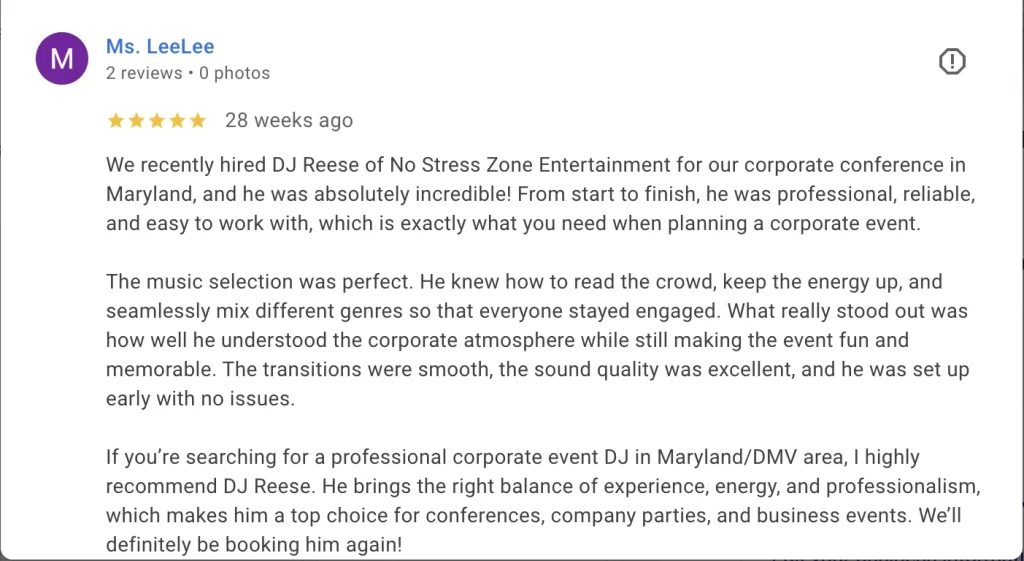
“DJ Reese is great! Very professional and kept the crowd engaged. Would definitely work with again. Thank you for such a great set!”
— Lizzy Mason, Diversity Alliance for Science East Coast Conference, 2025. Google review
What Played on the Floor, Track by Track
Planners ask what the music actually is, and most entertainment websites answer with a genre list. Here is the running order from the evening program at that conference, 6:30 to 9:30 PM, pulled straight from our Serato history log. Thirty eight tracks, in the order the room got them. The tracks are the easy part. The order is the work.
6:30 PM. Opening the room. People are still holding drinks and finishing conversations from the last session. Nobody is dancing yet, and pushing them to is how you lose a room this early. Disco and funk carry the first half hour. Familiar, mid tempo, high energy, and it asks nothing of anybody.
- Boogie Wonderland, Earth Wind and Fire
- Shake Your Groove Thing, Peaches and Herb
- Street Player, Chicago
- We Got The News, Steely Dan
- Forget Us Nots, Patrice Rushen
- Ain’t No Stoppin’ Us Now, McFadden and Whitehead
- Jungle Boogie, Kool and The Gang
- We Can’t Go For That, Hall and Oates
- Fantasy, Earth Wind and Fire
Building. Motown into early eighties. The tempo comes up and the first group commits to the floor. Once that happens the night has a shape and everything after it is easier.
- We Want You Back, The Jackson 5
- We Wanna Be Where You Are, Michael Jackson
- Workin’ Day And Night, Michael Jackson
- Stayin’ Alive, Bee Gees
- It’s Tricky, Run DMC
- Cool It Now, New Edition
- Whip It, Devo
- Hit Us With Your Best Shot, Pat Benatar
- Abracadabra, Steve Miller Band
- Sweet Dreams, Eurythmics
- Dracula, Tame Impala
Widening it. This was a diverse crowd, which is normal for a national conference and is the thing a one lane set gets wrong. A set that stays in a single genre will hold part of a room and quietly lose the rest of it, and the part you lose does not complain. They just stop coming back to the floor.
- Conga, Gloria Estefan and Miami Sound Machine
- Danza Kuduro, Don Omar and Lucenzo
- Echa Pa’lla, Pitbull
- Calabria 2008, Enur
- Waka Waka, Shakira
- Jerusalema, Master KG
- Follow The Leader, Soca Boys
Line dances. These are not on the list because they are great records. They are on the list because they are instructions. There is a point in every evening where a room is willing but self conscious, and a song that tells people what to do with their feet will move more bodies than a better song that does not.
- Cupid Shuffle, Cupid
- Wobble, V.We.C.
- Cha Cha Slide, DJ Casper
- Electric Boogie, Marcia Griffiths
- Cotton Eye Joe, Rednex
The last half hour. By this point the floor has sorted itself out and told you who is still there. We went where the energy was rather than where the plan said to go.
- Shararat, Dhurandhar
- Desi Girl, Dostana
- Abhi Toh Party Shuru Hui Hai, Badshah
- Mundiyaan To Bach Ke Rahi
- Let’s Nacho, Kapoor and Sons
That block was not planned in a spreadsheet six weeks out. It was a read, and it is the reason we keep a library that runs further than the genres a planner would think to ask about on a briefing call. The thing that decides whether the last half hour of a conference reception works is usually not in the brief.
Close.
- Don’t Stop Believin’, Journey
A conference reception is not a wedding and it is not a club. People have been in sessions since morning, they are wearing badges, and a good number of them are still working the room. The music has to be strong enough to move them and neutral enough that nobody in a senior role feels talked down to. Reading which of those two the room needs, minute by minute, is the actual job.
Conference Work, Documented
Three write-ups of conference and summit programs we have run, with the rooms, the audience sizes and what the job actually involved:
- Alliance for Science, East Coast Conference — the full case study for the conference described above, 2025 and 2026
- RMS Sales Kickoff — hosting a 500 attendee sales kickoff at Martin’s Crosswinds, Maryland
- FTF News Annual Awards — awards programming for a financial technology conference in New York
Coverage by Event Phase
Pre-event and registration. The music during registration creates the first impression of the entire event. Music during this phase sets the tempo and tone — welcoming, professional, and energizing without overpowering registration conversations. Volume control and genre selection during this window are carefully managed to signal that something great is about to happen.
General session support. The music during general sessions includes managing walk-on music for keynote speakers, maintaining energy between presentations, and providing audio support for video playback transitions. We work from your final run of show and adapt in real time when sessions run long or short.
Networking and evening events. After-hours and networking events require a complete energy shift. The room goes from professional to social in minutes, and the music has to lead that transition. DJ Reese manages that shift deliberately — bringing the energy up gradually while reading the crowd’s response and adjusting accordingly.
We have supported events from 150 to 3,000 attendees across industries including technology, finance, healthcare, and associations. Contact us to discuss your upcoming conference or summit.
What Is Included
Our conference work goes well beyond playing music between sessions. Before the event, we review the full conference agenda, the speaker lineup, any sponsor activations that involve entertainment, and the overall tone and objectives for the conference. We build a music strategy that serves each phase of the event and create a plan for managing transitions between program elements.
On-site, we coordinate with your AV team, your program producer, and your conference manager to ensure every handoff is clean. We monitor the room constantly and adjust in real time based on what we observe — not just following the clock. When a session runs long, we know how to compress the transition. When the energy in the room dips, we know how to bring it back before it becomes visible to attendees.
Sustaining Energy Across Multiple Days
Multi-day conferences present a unique challenge: sustained energy over an extended period. Day two of a conference is almost always harder to manage than day one. Attendees are fatigued, the novelty has worn off, and the temptation to check out is higher. Managing the energy arc across multiple days requires a different strategy than managing a single-day event.
We build specific music plans for each day of a multi-day conference, calibrated to where attendees are in their conference experience. Day one arrival gets one treatment. Day two morning — when re-engagement is the priority — gets another. The evening networking event on day one gets an entirely different approach from the closing session on day three. Every phase has its own energy requirement and its own music strategy.
Frequently Asked Questions
Can you cover events with multiple breakout rooms?
Yes. We can coordinate entertainment across main stage and breakout environments, working with your AV team to ensure each space has appropriate music and energy management for the programming happening in it.
Does this include MC hosting?
Yes. Every conference engagement includes the option for fully integrated MC hosting — managing program flow, introducing speakers, facilitating audience engagement moments, and keeping the conference on time from the booth.
What does a conference DJ cost?
Conference and summit work runs $2,500 to $10,000 per day. The range moves with the number of days, how many rooms need coverage, total hours on site, and travel. Multi-day programs are quoted as a package rather than per day, and you get the number before you get a contract.
How far in advance should we book?
About six months out for corporate conferences. April through December is the busiest stretch, and dates inside that window go first. If your program is still in planning, an early conversation costs nothing and holds nothing against you.
Do you travel outside the Philadelphia area?
Yes. We work New York City, Philadelphia, Washington DC, Atlanta and Los Angeles regularly, and we take bookings nationwide. Travel and accommodation are quoted separately and shown as line items, not buried in the fee.
Do you bring the sound system, or work with our AV company?
Either. On large conferences there is almost always an AV or production company running house sound, and in that case we plug into their system and work to their patch. For smaller rooms and breakouts we can provide sound. Tell us which situation you are in and we will tell you what we need.
What do you need from us before the event?
The final run of show, walk-on preferences for your speakers, the timing of breaks and meals, and a contact for the AV lead. We ask for a production call ahead of the event so the music is planned against your schedule rather than improvised on the day. If your planner holds the CMP credential from the Events Industry Council, they usually have all of this documented already and the call is short.
What happens if a session runs long?
It usually does. We watch the room and the clock rather than the printed schedule, and we adjust from the booth. If your keynote overruns by twelve minutes, the transition music shortens and the break music starts later. Nobody in the room should be able to tell anything moved.
How do you keep energy up on day two and day three?
By planning the arc across the whole program instead of treating each day as a fresh start. Day two of a conference is a different room than day one, with the same people in it, and the music has to acknowledge that. This is the part of a multi-day booking that a single-event DJ has never had to solve.
Do you work with association conferences and trade shows?
Yes. Association meetings and exhibitions have their own rhythm, with exhibit hall hours, committee sessions and awards programming layered on top of general sessions. ASAE represents the association executives who run these, and IAEE the exhibition side. If your event has an exhibit floor, say so early, because it changes where the sound goes.
Our work is trusted by event planners and conference producers nationwide. When you need summit entertainment services that go beyond pressing play, DJ Reese delivers. From general session openers to closing night celebrations, our DJ services for conferences and summits keep the energy locked in and your audience moving.
Every conference and summit DJ support engagement begins with a deep dive into your program objectives, audience profile, and event arc — so our conference and summit entertainment are built around your event, not around a playlist. If you’re planning a conference or corporate summit and need entertainment that makes the room feel like something, let’s talk.
Summit entertainment services from DJ Reese are designed specifically for conferences, leadership summits, and multi-day corporate events. Unlike general entertainment, our DJ services for conferences and summits are calibrated to the structure of your event: the morning general session, the breakout-to-lunch transition, the post-lunch energy dip, and the closing night reception. Each phase requires a different approach, and our conference and summit DJ support are built to handle all of them.
When you hire conference and summit entertainment from No Stress Zone Entertainment, you’re not hiring someone to press play. You’re hiring a specialist who understands that your audience’s emotional state is a managed outcome — not a happy accident. Our summit entertainment services have supported Fortune 500 national conferences, association summits, and multi-track industry events where keeping the room energized across two or three days is the real challenge.
More on Booking a Conference DJ
- 7 tips to elevate your conference with the right DJ
- 9 questions every planner should ask before booking
Running Music and Audio for Multi-Day Conferences and Summits
Conference and summit audio work is less about a single set and more about managing energy across an entire multi-day event. Opening keynote walk-ins, breakout session transitions, networking breaks, and closing night receptions each need a different musical approach, and we build a day-by-day plan before the event even starts so nothing feels improvised on-site.
Breakout session transitions are one of the most overlooked details at large conferences. A 90-second high-energy track between sessions helps re-focus a room that just spent an hour sitting through a dense presentation, and it signals clearly that the next session is about to start without anyone needing to make an announcement.
Networking breaks and expo hall floors need a completely different mix: low-key, conversation-friendly instrumental or lounge tracks at a volume where two people standing three feet apart can still hear each other clearly. Getting this balance wrong is one of the most common complaints we hear about conference audio from other vendors, and it’s one of the easier things to get right with the right playlist strategy.
Closing night receptions at multi-day summits are where the energy can finally open up, and we coordinate with the event producer on exactly when to make that shift so it doesn’t feel jarring after two or three days of a more buttoned-up program. A well-timed transition from professional to celebratory tells attendees the working part of the conference is officially over.
Coordinating With the Production Team at Large Conferences
Large summits typically involve a full production team: AV vendors, a stage manager, lighting operators, and sometimes a separate general session producer. We integrate directly into that team rather than operating as a standalone vendor, joining production calls ahead of the event and confirming exactly how audio routing works between the main stage system and our own equipment for breakout rooms or the reception space.
Badge scanning stations, registration desks, and expo hall entrances also benefit from a light audio touch, something upbeat enough to set an energetic first impression without competing with the announcements or way-finding conversations happening at check-in. We coordinate this with whichever team is managing registration so the volume and playlist match the pace of attendee flow throughout each morning of a multi-day event.
Post-event surveys from conference attendees consistently mention audio and energy management among the details that shape their overall impression of an event, even when it’s rarely the headline takeaway. Getting the small transitions right across a multi-day summit adds up to a noticeably smoother experience for everyone in the room, session after session.
The music should adapt to a multi-day agenda, not force the agenda to work around a fixed playlist, and that flexibility is built into every proposal we put together. If your planning committee is comparing options, we are happy to walk through exactly how we would approach your specific agenda.
What Happens After the Final Session Ends
The work does not stop when the closing keynote wraps or the last song of the evening reception fades. Every engagement ends with a structured wrap up: gear breakdown coordinated around the venue’s teardown schedule and a short debrief with the planning committee while details are fresh. That wrap up also includes a written recap covering what worked, what we would adjust, and any equipment notes worth flagging for next year.
For multi-day conferences and summits, that debrief matters even more, since a program running across three or four days generates plenty of small lessons: which breakout rooms needed better sound isolation, which transitions felt rushed, and which sponsor activation pulled the most foot traffic. We fold all of that into the notes we hand back to the planning team.
Clients who rebook year after year say this follow-through is one reason they keep calling. A one-time vendor disappears the moment the load-out truck pulls away.
We would rather build a working relationship with your team, one that carries institutional knowledge into next year’s planning conversations. If your committee is already looking ahead, we are glad to start that conversation early, before RFP season gets crowded with requests from every other planner doing the same thing.