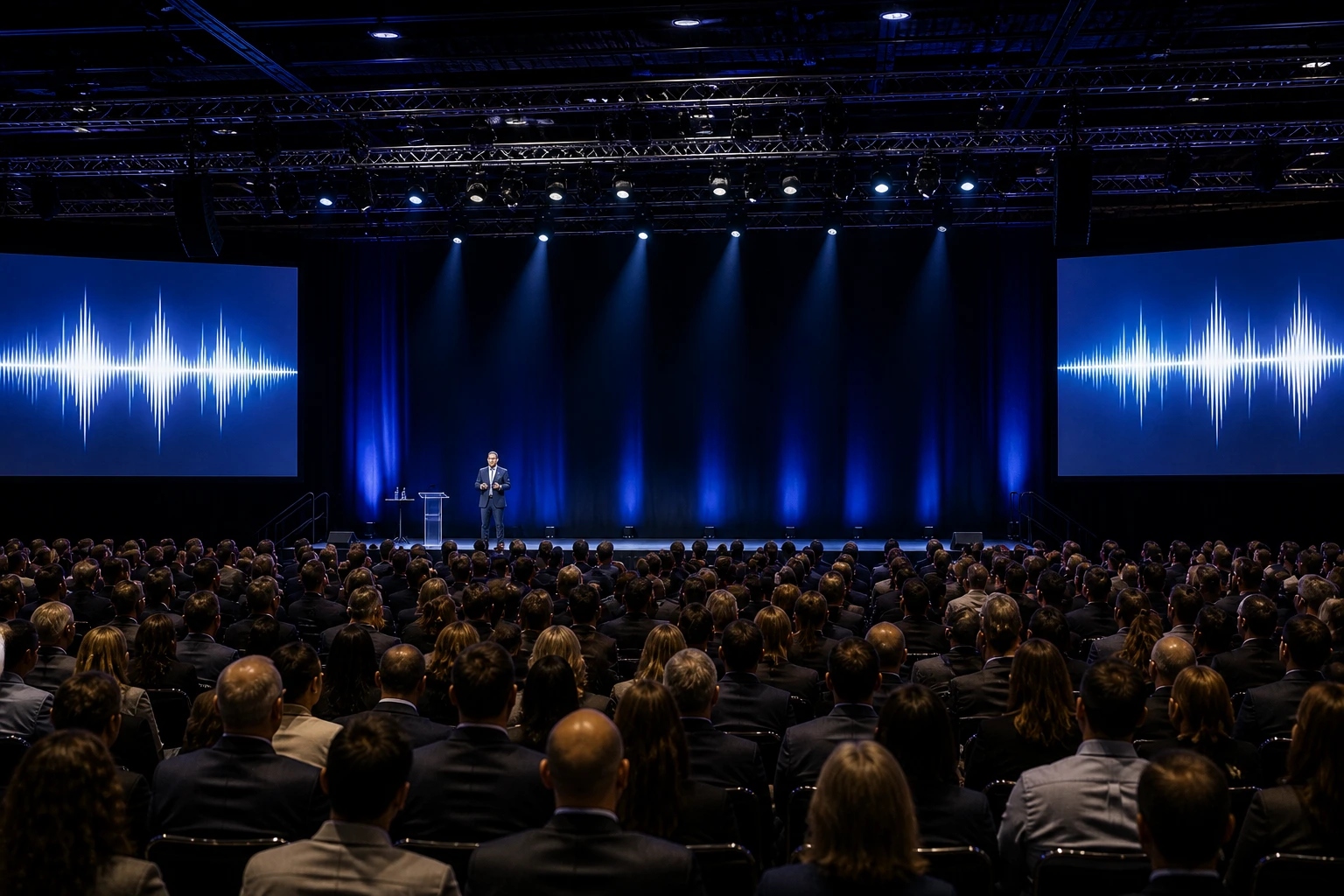
Knowing how to host a corporate conference is one of the highest-stakes operator skills in corporate events. A multi-day room with hundreds of attendees, multiple keynote speakers, sponsor activation moments, awards segments, networking blocks, and tight run-of-show timing across consecutive days requires an operator who can host a corporate conference at senior operator depth. Get it right and leadership remembers the conference as polished from arrival to load-out. Get it wrong and the program reads as clunky regardless of how strong the content is. Here are seven essential tips to host a corporate conference at Fortune 500 standard.
What It Means to Host a Corporate Conference
To host a corporate conference is to run the operational program control layer across the full length of the program. The operator who can host a corporate conference is responsible for opening each day, bridging between speakers, handling awards segments, managing sponsor moments, running networking blocks with the right energy register, and closing each day in a way that brings attendees back fresh the next morning. The work is not single-room performance. It is multi-day operational stamina applied to a program where every day builds on the last.
The operator who can host a corporate conference also reads the brand register across the full program. Tone calibrated to the audience profile. Language matched to the corporate voice. Walk-on energy matched to each speaker tier. Across three consecutive days, the operator maintains brand consistency from minute one of day one to the close of day three. A wedding-style emcee using their normal tone signals immediately to senior planners that the operator is in the wrong lane.
The Seven Essential Tips to Host a Corporate Conference
1. Map the Multi-Day Energy Arc Before the Agenda
To host a corporate conference well, the operator maps the multi-day energy arc before the agenda is finalized. Day one starts at a controlled peak with the welcome keynote. Day two holds steady through deep-content sessions. Day three rises to the closing peak and the awards segment. Drawing this multi-day arc first lets the operator match every programming decision to the intended emotional cadence across days. Without the arc, day two often sags and the conference loses momentum.
2. Script Every Daily Opening
The first three minutes of each conference day set the tone for the next eight hours. An operator who knows how to host a corporate conference scripts each daily opening — energy that pulls the room into the day’s theme, framing of what is coming, and a clean handoff to the first speaker. The opening is rehearsed and timed to the second. Done right, attendees lean in before the keynote starts. Done poorly, the keynote works uphill from minute one of every day.
3. Bridge Speaker Transitions Across All Sessions
Multi-day conferences run dozens of speaker transitions. To host a corporate conference at scale, the operator pre-scripts every transition — outgoing acknowledgment, narrative bridge, incoming intro. The audience never feels the transitions because they have been designed to disappear. Across three days of programming, this transition work is where most conferences either hold together or fall apart.
4. Handle Multi-Day Scope Shifts
Conferences always shift mid-program. A keynote runs long. A guest speaker reschedules. A sponsor session gets moved. An operator who can host a corporate conference has systems for handling these shifts across days without escalating to the planner. Backup intros for late speakers. Pre-scripted filler narration if a segment needs a one-minute hold. A clear protocol for moving content to a later block. The audience never knows the program changed because the operator absorbed the change.
5. Coordinate With the Full Production Stack
To host a corporate conference at premium level, the operator syncs with the entire production stack. The AV team. The content team running screen graphics. The lighting designer. The video crew capturing for post-event use. The sponsor activation team. Each handoff has to be cued, rehearsed, and held across multi-day execution. The operator who can host a corporate conference is the operational hub of the production, not a vendor adjacent to it.
6. Anchor the Awards or Recognition Segment
Many corporate conferences include an awards segment — President’s Club, industry recognition, sponsor partner awards. To host a corporate conference that includes awards, the operator runs walk-on music tight to the second, builds anticipation in the pauses before reveals, and lifts the room momentum on the way out. The awards segment becomes the emotional centerpiece of the conference when executed well.
7. Engineer the Closing Arc
The last twenty minutes of the conference determine how attendees and leadership remember the entire program. The operator who knows how to host a corporate conference engineers the closing arc with intention — a controlled rise of energy through the closing keynote, a clean handoff to closing remarks, a track that exits the room with the audience. Most conferences end on accident. The ones that get remembered end on purpose.
When You Need an Operator to Host a Corporate Conference
Not every corporate conference needs a senior operator. A small internal team summit does not. A 500-person multi-day conference with multiple speakers, awards programming, sponsor segments, and leadership in the room does. The threshold is whether the program runs longer than a single day, whether multiple production elements need coordination, and whether the audience profile requires brand-register precision. At that threshold, hiring an operator to host a corporate conference is what separates a polished program from a clunky one.
Pricing scales with conference length and scope. A senior operator to host a corporate conference typically charges $8,000-$18,000 for a two-day program and $14,000-$25,000+ for three-day programs with extensive awards segments, multiple keynote speakers, and tight production coordination requirements. The cost reflects the multi-day operational scope.
How to Book
The fastest path to a real quote is the pricing calculator on this site — it returns a real-world estimate in under thirty seconds based on conference length, location, audience size, and add-ons. From there, a planning call walks through the multi-day run-of-show. The full proposal arrives within forty-eight hours of that conversation.
For industry-level context on multi-day conference execution standards, see resources from BizBash, the leading publication for event professionals. For related operator-tone reading, see: conference and summit DJ services, gala and awards DJ services, executive and private function DJ services, and the corporate DJ pricing calculator.
FAQ
Can the same operator host a corporate conference and also DJ?
Yes — senior operators in this lane typically handle both. The operator who can host a corporate conference also runs the music portion of the program (walk-ons, transitions, bridges, closing arc) which removes coordination friction across multi-day programs.
How early should we book?
For premium dates, lock in the operator who will host a corporate conference six months out. Q1 conference season and Q4 year-end programs fill earliest. Multi-day national conferences at major venues often book nine to twelve months in advance.
What about virtual or hybrid conferences?
An operator who can host a corporate conference in person can typically also handle hybrid programs with a streamed component. The streaming layer adds production-aware audio considerations but does not change the operational fundamentals of the host role.
Service Areas and Contact
Primary service metros include New York, Washington DC, Los Angeles, Philadelphia, Atlanta, and the full New Jersey tri-state area. Travel happens nationwide for the right project. For urgent timelines, direct contact at [email protected] or (856) 538-2582 gets a same-day response. DJ Reese has been the experience designer behind LIDL US grand openings, PUMA brand activations, Fox Corporation internal programs, and Fortune 500 corporate events nationwide since 2007. Seven plus years of operator-first execution behind every booking, and 105 Google reviews at five stars to back it up.
Why Repeat Clients Keep Booking
The clearest signal of operator quality is whether senior planners book the same person twice. DJ Reese has executed repeat engagements for LIDL US across multiple grand opening cycles, returned to PUMA brand activations on consecutive campaign cycles, and rebooked annually for Fox Corporation internal programs and Adidas team events. Repeat bookings happen for one reason — the operational layer holds up. Run-of-show coordination is reliable. Mid-event scope shifts get handled without escalation. The program runs as designed from arrival to load-out.
Senior planners do not have time to babysit a vendor. They book operators who handle the entire scope independently and surface only what genuinely requires their attention. That dynamic is the reason senior planners pay senior rates — not because the music is better, but because the operational reliability frees the planner to focus on the parts of the program only they can run.
What Goes Into the Pre-Event Planning Call
The pre-event planning call is where the framework gets built. The operator walks through the run-of-show document line by line. Speaker handoff timing. Awards segment cadence. Sponsor activation moments. Brand-safe music limits. Audience demographic notes. Venue specifics. Out of that call comes the cue sheet, the transition sting script, the pre-staged backup library, and the contingency plan for the most likely mid-event scope shifts.
Planners new to working with a senior operator sometimes ask whether all of this prep work is necessary. The honest answer is that the prep is what makes the on-event execution invisible. Without it, the operator improvises during the event, which the audience feels even if they cannot name what is wrong. With it, the audience experiences a program that feels designed without ever noticing the design. That perception gap is the entire reason senior corporate operators charge premium rates.
What Most Operators Get Wrong in This Lane
The most common failure mode is treating multi-day execution as the same scope as single-event work. Operators who handle one-day galas often struggle when the same skill set has to sustain across three consecutive days with different audiences in the room each morning. The discipline shifts. The fatigue management matters. The energy curve gets harder to read by day two. The operator who can run three full days at senior level is rarer than the operator who can run one.
The second failure mode is treating the daily opening as a repeat. Each conference day deserves its own opening, framed around what that specific day delivers. A copy-paste opening on day two signals to the audience that the operator is on autopilot. The audience tunes out earlier as a result, and the day takes longer to build.
Service Areas and How to Start
Primary service metros include New York, Washington DC, Los Angeles, Philadelphia, Atlanta, and the full New Jersey tri-state area. Travel happens nationwide for the right project. Multi-day national conferences at major venues often book nine to twelve months in advance. The smartest planners run their operator booking on the same timeline as their venue booking, which removes the late-stage scramble to find a senior-grade operator after the rest of the production stack is locked.
For urgent timelines, direct contact at [email protected] or (856) 538-2582 gets a same-day response. The fastest path to a real conversation is the pricing calculator on this site, which returns a real-world estimate in under thirty seconds based on conference length, location, audience size, and add-ons.
Bottom line: the operator who can host a corporate conference at senior level is who delivers the program your leadership remembers as polished. The discipline shows up in the multi-day energy arc, the daily openings, the speaker transitions, and the closing arc. Get the operator right and the conference runs as designed. Get it wrong and the production stack does extra work to compensate. The smartest path to host a corporate conference at Fortune 500 standard is to book the operator early, walk through the full run-of-show together, and trust the framework to hold across all three days. Senior operators who host a corporate conference well make the job look easy because they did the prep work invisible to the audience.
The bookings that go best start months before doors open. The bookings that stretch the operator past their best work are the late ones that arrive with the run-of-show still in flux. Lock in early and the program executes the way it was designed to.