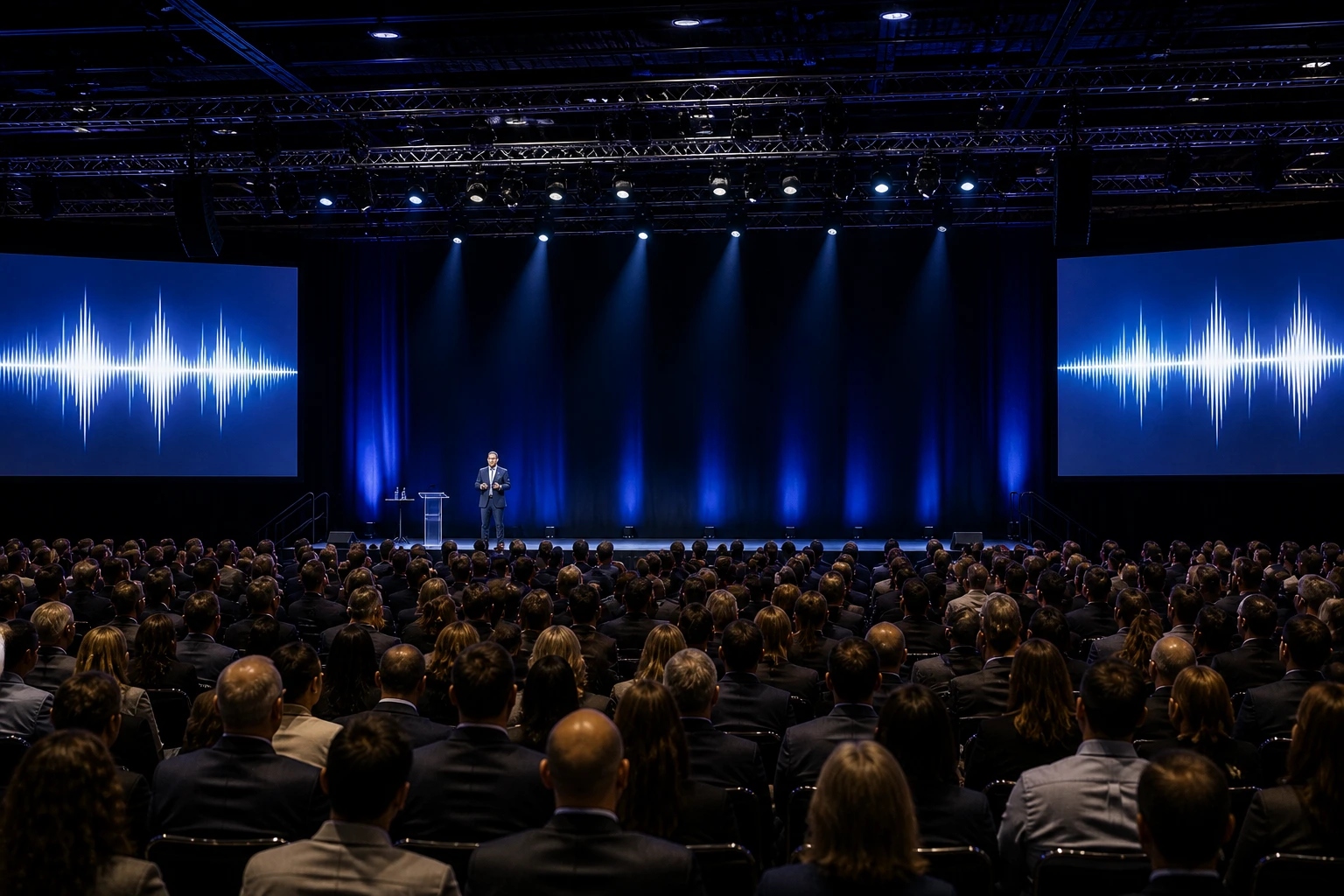
A corporate awards show host is the operator who runs the highest-stakes window of any corporate event. The corporate awards show host opens the segment, builds anticipation in the pauses before names are read, runs the walk-on music tight to the second, manages the speaker handoff back to leadership, and lifts the room momentum on the way out. The work is not on-stage presence. The work is operational program control with a microphone and a music rig in front of senior leadership watching every cue. Here are seven essential tips a corporate awards show host applies to every awards program in 2026.

What a Corporate Awards Show Host Actually Does
A corporate awards show host runs the awards segment as a designed sequence, not a list of name reads. The corporate awards show host opens with energy that pulls the room into awards mode, builds suspense before each reveal, lifts the music as winners cross the stage, holds the room during acceptance moments, and bridges between awards categories without losing momentum. Behind the scenes, the corporate awards show host coordinates with the AV team on screen content cues, syncs with the photographer for capture timing, and adjusts in real time when an award recipient is not in their seat.
The corporate awards show host also serves as the brand voice during the most public-facing moment of the corporate event. Recipients remember which awards programs honored them well. Senior leadership notices which awards programs ran cleanly versus which ones dragged. The audience tells stories about awards moments for months after the program. A corporate awards show host who runs the segment without the right operational layer creates moments people remember for the wrong reasons.
The Seven Essential Tips for a Corporate Awards Show Host
1. Script Every Award Read
A corporate awards show host scripts every award announcement before the event. The category framing. The recipient name pronunciation. The achievement summary. The walk-on cue. Improvising any of these elements live introduces risk that does not need to exist. A scripted read with rehearsed phrasing lets the corporate awards show host focus on the audience and the energy, not on the words themselves.
2. Pause Before Every Reveal
The pause before a name is read is what makes the moment land. A corporate awards show host holds that pause deliberately — two to four seconds of silence as the music dips, the screen content holds, and the audience leans forward. The pause is the difference between an award that feels significant and an award that feels routine. Recipients remember the pause. Leadership notices the pause. The corporate awards show host who skips the pause hands away the most powerful tool in the segment.
3. Walk-On Music Timed to the Second
Walk-on music is the signature operational move of a corporate awards show host. The music has to hit the exact frame the name is announced. The volume has to lift cleanly as the recipient crosses the stage. The energy has to match the award category — celebratory but not over the top, dignified but not flat. The corporate awards show host pre-stages a walk-on track for every category, with backup options ready in case a recipient is not where expected when their name is called.
4. Hold the Room During Acceptance Speeches
Some recipients deliver a fifteen-second thank-you. Others give a four-minute speech. A corporate awards show host holds the room through both. The music stays out of the way. The lighting stays held. The energy stays steady so the recipient feels supported. When the speech ends, the music comes back at a controlled level that bridges to the next award without breaking the moment that just happened. Done right, the audience never feels the pacing differences between speeches.
5. Manage the Recipient Photo Window
After every award, the recipient typically poses with the presenter for the event photographer. A corporate awards show host holds the music at a designed level during this photo window, gives the photographer enough time to get the shot, and bridges to the next award once the recipient steps off stage. The photo window is short — usually fifteen to thirty seconds — but the timing has to be right or the photographer misses the shot and the recipient gets self-conscious. Smooth photo windows are an operational signal of a well-run program.
6. Bridge Between Award Categories
Multi-category awards programs need bridges. A corporate awards show host scripts the narration that ties one award category to the next, frames the relevance of the next category, and maintains room momentum across the full segment. Without the bridges, awards programs read as a list. With them, the segment reads as a sequence. The bridge work is invisible when done well and obvious when done poorly.
7. Close the Awards Segment With Intention
The close of the awards segment determines what the room carries into the rest of the night. A corporate awards show host engineers the close with intention — a final acknowledgment that frames the achievements as a collective signal, a music swell that lifts the energy, and a clean handoff back to the closing remarks or after-party programming. The segment leaves the audience energized rather than awards-fatigued.
When You Need a Corporate Awards Show Host
Not every corporate event with awards needs a dedicated corporate awards show host. A small internal team recognition does not. A 300-person annual gala with a fifteen-category awards program does. A 500-person association event with industry recognition awards does. A sales kickoff with a President’s Club segment does. The threshold is whether the awards segment runs longer than thirty minutes, whether multiple categories need bridging, and whether leadership is presenting the awards. At that threshold, the corporate awards show host is what separates a polished awards segment from a clunky one.
Pricing for a corporate awards show host typically starts at $4,000 for a standard half-day program with a single awards segment and scales to $9,000+ for full-day galas with extensive multi-category programs, leadership-presented awards, and tight production coordination requirements. The cost reflects the operational scope — not stage time. A corporate awards show host doing the work right is doing two or three hours of visible work and ten or fifteen hours of invisible prep work.
How to Book a Corporate Awards Show Host
The fastest path to a real quote for a corporate awards show host is the pricing calculator on this site — it returns a real-world estimate in under thirty seconds based on program length, location, awards segment scope, and add-ons. From there, a planning call walks through the awards categories, the recipient list, the run-of-show, and the specific operational requirements. The full proposal arrives within forty-eight hours of that conversation.
For industry-level context on awards program execution and corporate event production standards, see resources from BizBash, the leading publication for event professionals. For related operator-tone reading, see: gala and awards DJ services, conference and summit DJ services, executive and private function DJ services, and the corporate DJ pricing calculator.
Why Senior Planners Rebook the Same Corporate Awards Show Host
The clearest signal of operator quality is whether senior planners book the same corporate awards show host twice. DJ Reese has executed repeat engagements for LIDL US across multiple grand opening cycles, returned to PUMA brand activations on consecutive campaign cycles, and rebooked annually for Fox Corporation programs. Repeat bookings happen for one reason — the awards segment runs cleanly. The pauses land. The walk-ons hit. The recipients feel honored. Leadership notices the difference.
Senior planners do not have time to babysit an awards host. They book operators who handle the segment independently and surface only what genuinely requires their attention. That dynamic is why senior planners pay senior rates — the corporate awards show host is the operational reliability layer that frees the planner to focus on the parts of the program only they can run. Service metros include New York, Washington DC, Los Angeles, Philadelphia, Atlanta, and the full New Jersey tri-state. Travel happens nationwide for the right project.
Frequently Asked Questions
What is the difference between a corporate awards show host and an emcee?
A corporate awards show host is an emcee specifically trained for awards segment execution. The corporate awards show host knows the pacing, the pause work, the walk-on music timing, and the photo window management that awards programs require. A general emcee can host a corporate event but may not have the awards-specific operational depth.
Does a corporate awards show host also DJ?
In most senior bookings, yes. The corporate awards show host typically also runs the music portion of the program — walk-on tracks, transition stings, bridge music between categories, closing arc. Having one operator handle both removes coordination friction.
How early should we book?
Lock in the corporate awards show host sixty to ninety days before event date. Q4 holiday season and Q1 conference season fill earliest. For premium gala dates at major venues, four to six months out is the safer planning window.
Service Areas and Contact
Primary service metros include New York, Washington DC, Los Angeles, Philadelphia, Atlanta, and the full New Jersey tri-state area. Travel happens nationwide for the right project. For urgent timelines, direct contact at [email protected] or (856) 538-2582 gets a same-day response. DJ Reese has been the experience designer behind LIDL US grand openings, PUMA brand activations, Fox Corporation internal programs, and Fortune 500 corporate events nationwide since 2007. Seven plus years of operator-first execution behind every booking, and 105 Google reviews at five stars to back it up.
What Most Operators Get Wrong in This Lane
The most common failure mode is treating awards as a list-reading exercise. Operators who run on pure stage presence get lucky in some rooms and crater in others. The discipline shows up in the pre-event script work, the rehearsed pauses, the pre-staged walk-on tracks for every category, and the photo window timing. Without that prep, the segment becomes its own experiment with senior leadership and award recipients as the test subjects.
The second failure mode is over-personalizing. Some operators inject so much commentary between awards that the segment becomes about them rather than the recipients. The right ratio is heavy preparation, light delivery. The award is the moment. The recipient is the focus. The operator behind the booth is the operational layer that makes the moment land cleanly without competing for it.
What Goes Into the Pre-Event Planning Call
The pre-event planning call is where the framework gets built. The operator walks through the awards categories one by one. The recipient list. The pronunciation of each name. The achievement summary the screen content team is using. The walk-on music tone for each category. The expected length of acceptance speeches. Out of that call comes the cue sheet, the transition sting script, the pre-staged backup music library, and the contingency plan for the most likely awards-segment shifts.
Planners new to working with a senior operator sometimes ask whether this much prep is necessary for a smaller awards segment. The honest answer is that the prep is what makes the on-event execution invisible. Without it, the operator improvises during the segment, which leadership and recipients both feel even if they cannot name what is wrong. With it, the segment runs as designed without anyone noticing the design. That perception gap is the entire reason senior operators charge premium rates for awards work specifically.
A Word on Q4 Awards Season Timing
Q4 awards season — October through December — is the busiest stretch on the corporate event calendar. Year-end recognition galas, President’s Club awards programs, holiday party awards segments, and annual industry recognition events all stack into the same nine-week window. The operator pool that actually does this work well at senior levels is meaningfully smaller than the general DJ market. Premium dates lock four to six months out. Booking in June for a December gala is normal. Booking in October for a December gala almost always means accepting the second-tier operator pool.
For Q1 annual conference awards programs, timing is slightly more flexible — usually three months out is enough for premium dates. For mid-year industry awards programs, two months out is the minimum safe window. The investment range scales with the booking timeline, but more importantly with the scope: half-day single-category programs run different rates than full-day multi-category galas at major venues.