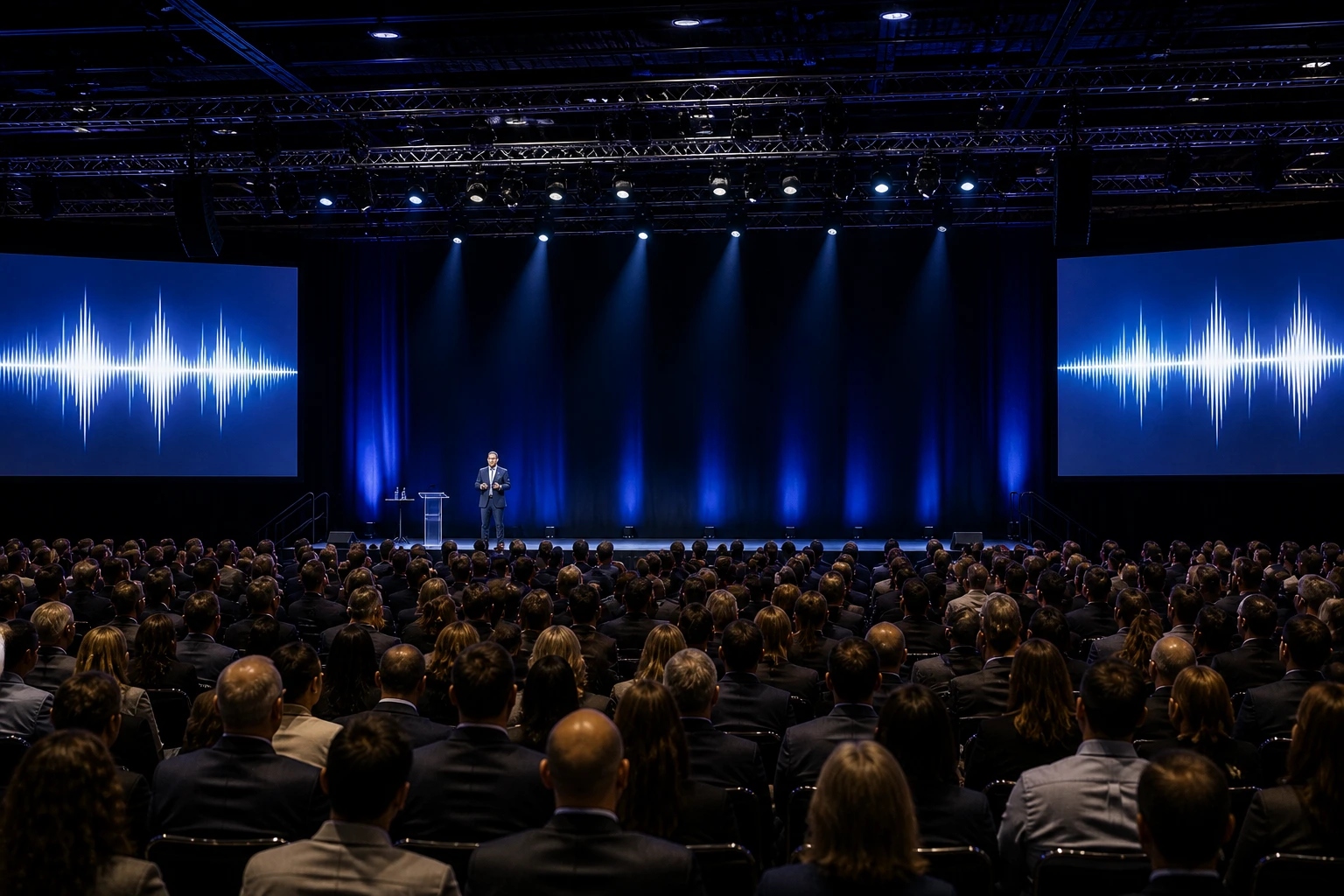
Knowing how to keep energy up at corporate events is the single biggest skill that separates a corporate operator from a wedding DJ pitching corporate work. Keep energy up at corporate events and the room remembers the program. Lose the energy for fifteen minutes and the recap email writes itself in the wrong direction. The work is not about the playlist. The work is about reading the room in real time and making the adjustment before the room knows there was a problem. Here are seven operator moves that keep energy up at corporate events when leadership is in the room and the program cannot afford to stall.
Why You Have to Keep Energy Up at Corporate Events
Corporate events do not run on momentum. They run on designed sequences that have to be actively maintained from arrival to load-out. Keep energy up at corporate events and leadership remembers the program as polished. Lose the energy at any extended dip and the same leadership remembers the program as clunky. The audience cannot articulate exactly why a corporate event felt off — but they always know. The operator who knows how to keep energy up at corporate events is the operator senior planners rebook.
What kills energy at corporate events is rarely dramatic. It is the five-minute gap between a keynote and the next speaker. It is the awkward thirty seconds during an award handoff. It is the seventeen-minute lag between the dinner course and the after-dinner program. The operator who can keep energy up at corporate events sees these gaps coming and works them invisibly. The audience never feels the transition because it was designed.
The Seven Operator Moves to Keep Energy Up at Corporate Events
1. Read the Room Every Fifteen Minutes
To keep energy up at corporate events, the operator runs a fifteen-minute room check throughout the program. Where is the audience looking? Is the conversation building or thinning? Are people leaning forward or checking phones? The fifteen-minute interval gives enough time for the previous adjustment to land and enough notice to make the next one before a dip becomes obvious. This is not a passive observation — it is an active diagnostic that determines the next thirty minutes of programming.
2. Pre-Script Every Speaker Transition
Speaker transitions are where most corporate programs stall. The operator who plans to keep energy up at corporate events scripts every transition before the doors open. Outgoing music beat, clean handoff cue, incoming energy match to the next speaker. The audience never feels the transition because it has been rehearsed. When transitions stall, leadership notices. When transitions land, leadership notices the speakers, not the operator. That is the goal.
3. Have Three Backup Energy Plays Ready
To keep energy up at corporate events when something unexpected happens, the operator carries three backup plays in their head at all times. A high-energy track for moments that need an immediate lift. A medium recovery track for moments that need a soft pull back up. A graceful close-out track for moments where the program needs to fold cleanly. These plays get used maybe twice in a four-hour event. The other ninety percent of the time the program runs to plan. The plays exist for the ten percent where it does not.
4. Coordinate With the AV Team in Real Time
The operator who can keep energy up at corporate events does not run isolated. They sync with the AV team on cue handoffs throughout the night. The video content team knows when the music pulls back so their reveal lands. The lighting team knows when the energy is rising so their cue matches. The presentation team knows when their slide change is about to be reinforced by an audio cue. The room runs as a coordinated system, and the operator is the conductor of the audio layer of that system.
5. Plan the Energy Curve Before the Agenda
To keep energy up at corporate events from the moment doors open to the moment they close, the operator maps the intended energy curve before the agenda is even finalized. The arrival energy starts low and builds. The first keynote peak sits about thirty minutes in. Energy dips through dinner and rebuilds toward the closing remarks. The closing rises to a controlled peak. Drawing this curve first lets the operator match every programming decision to the intended emotional arc. Without the curve, the program runs on accident.
6. Anchor the Awards Segment
The awards segment is the highest-stakes window of any corporate event where leadership is awarded. To keep energy up at corporate events through awards, the operator runs walk-on music tight to the second, holds the room when announcements are read, builds anticipation in the pause before reveals, and lifts the energy clean when the winner crosses the stage. A poorly executed awards program drags. A well-executed one builds room momentum that carries through the rest of the night.
7. Engineer the Closing Arc on Purpose
The last twenty minutes of a corporate event determine how leadership remembers the program. To keep energy up at corporate events through to the very end, the operator engineers the closing arc with intention. Music that rises to a controlled peak. A clean handoff to the closing remarks. A track that exits the room with the audience instead of fading awkwardly. Most events end on accident. The events that get remembered end on purpose.
Real Examples of Energy Management at Corporate Events
DJ Reese has used these seven moves to keep energy up at corporate events across years of Fortune 500 work. At a PUMA brand activation, the energy curve produced $75,000 in three-hour sales because the room felt designed, not improvised. At 9/11 Day with New York Cares, holding the energy of 6,000+ volunteers across hours of meal packing enabled the team to pack more than 2 million meals. At LIDL US grand openings, foot traffic momentum at the door directly translated into store-wide attendance. The work is the same every time: keep energy up at corporate events through deliberate operator moves, not luck.
Working With an Operator Who Can Keep Energy Up at Corporate Events
The fastest path to bringing this level of execution into your next event is the pricing calculator on this site — it returns a real-world estimate in under thirty seconds based on event type, length, and scope. From there, a planning call walks through the run-of-show and the full proposal arrives within forty-eight hours. For industry-level context on event energy and engagement, see resources from BizBash. For related operator-tone reading, see: conference and summit DJ services, gala and awards DJ services, how to eliminate dead air at conventions, and the corporate DJ pricing calculator.
Frequently Asked Questions
What is the single biggest mistake operators make at corporate events?
Treating the event as a playlist. The operators who can keep energy up at corporate events treat the event as a designed sequence with intentional energy curves, scripted transitions, and pre-staged backup plays. The playlist is the last decision, not the first.
When does energy management start to matter for an event?
Energy management starts to matter the moment leadership will be in the room watching, or the moment the program runs longer than ninety minutes. Below that threshold, basic competence is enough. Above it, the operator who can keep energy up at corporate events is what separates a polished program from a clunky one.
How early should we book?
Lock in the operator sixty to ninety days before event date for premium dates. Q4 holiday season and Q1 conference season fill earliest. Booking late forces a stripped-down version of the work.
Why Senior Planners Rebook
The clearest signal of operator quality is whether senior planners book the same person twice. DJ Reese has executed repeat engagements for LIDL US across multiple grand opening cycles, returned to PUMA brand activations on consecutive campaign cycles, and rebooked annually for Fox Corporation programs and Adidas team events. Repeat bookings happen for one reason — the operational layer holds up. Run-of-show coordination is reliable. Mid-event scope shifts get handled without escalation. The room flow is intentional from arrival to load-out.
Senior planners do not have time to babysit a vendor. They book operators who handle the entire scope independently and surface only what genuinely requires their attention. That dynamic is the reason senior planners pay senior rates — not because the music is better, but because the operational reliability frees the planner to focus on the parts of the program only they can run. Service metros include New York, Washington DC, Los Angeles, Philadelphia, Atlanta, and the full New Jersey tri-state. Travel happens nationwide for the right project.
For urgent timelines, direct contact at [email protected] or (856) 538-2582 gets a same-day response. Most premium dates in Q4 holiday season and Q1 conference season get locked ninety days out, so earlier conversations almost always produce better outcomes than later ones. DJ Reese has been the experience designer behind LIDL US grand openings, PUMA brand activations, Fox Corporation internal programs, and Fortune 500 corporate events nationwide since 2007. Seven plus years of operator-first execution behind every booking, and 105 Google reviews at five stars to back it up.
What Most Corporate Operators Get Wrong
The most common failure mode is treating energy management as a vibe instead of a discipline. Operators who run on instinct alone get lucky in some rooms and crater in others. The discipline shows up in the fifteen-minute room checks, the pre-scripted transitions, the backup plays staged before doors open, and the post-event recap that captures what worked and what did not. Without the discipline, every event becomes its own experiment with leadership in the room as the test subjects.
The second failure mode is over-engineering. Some operators script every minute so tightly the program cannot breathe. Corporate events need flexibility because speakers run long and sponsors change segment order at the last minute. The discipline is in the framework, not the rigidity. A scripted transition can be adjusted in real time if the operator built the framework to accommodate change. A rigidly timed program with no built-in flex points falls apart the first time something shifts.
What Goes Into the Pre-Event Planning Call
The pre-event planning call is where the framework gets built. The operator walks through the run-of-show document line by line. Speaker handoff timing. Awards segment cadence. Sponsor activation moments. Brand-safe music limits. Audience demographic notes. Venue specifics. Out of that call comes the cue sheet, the transition sting script, the pre-staged backup library, and the contingency plan for the most likely mid-event scope shifts. By the morning of the event, every cue is rehearsed and every backup is staged.
Planners new to working with a senior operator sometimes ask whether all of this prep work is necessary for a smaller event. The honest answer is that the prep is what makes the on-event execution invisible. Without it, the operator improvises during the event, which the audience feels even if they cannot name what is wrong. With it, the audience experiences a program that feels designed without ever noticing the design. That perception gap is the entire reason senior corporate operators charge premium rates.
Investment and Service Areas
Pricing for senior corporate operator work typically starts at $3,000 for a standard package and scales based on event length, location, guest count, and production complexity. The pricing calculator on this site returns a real-world estimate in under thirty seconds. Primary service metros include New York, Washington DC, Los Angeles, Philadelphia, Atlanta, and the full New Jersey tri-state area. Travel happens nationwide for the right project. Out-of-state quotes factor in flight, accommodations, and any gear shipping or rental at destination.
When the Plan Meets the Real Room
The framework to keep energy up at corporate events is everything until the doors open. Once attendees walk in, the framework becomes a reference document and the operator becomes the program. To keep energy up at corporate events in real time means reading what the audience actually is — not what the planning call assumed. A keynote room with 400 in-person attendees feels different than the same room with 250. Programming designed for an evening gala does not transfer cleanly to an afternoon awards ceremony. The operator who can keep energy up at corporate events makes those adjustments in the first ten minutes after doors open and the room reveals itself.
Most veteran corporate planners can tell within twenty minutes whether the operator behind the booth can actually keep energy up at corporate events or is going to fight the room all night. The signal is small: how the transitions feel, whether the music matches the audience tone, how cleanly the first speaker gets handed off. By the awards segment, the verdict is already in. By the closing arc, leadership already knows whether to rebook. The work to keep energy up at corporate events plays out in those small moments more than in the obvious peaks.
The shorthand for whether the program is going right: senior planners stop watching the operator and start watching the speakers. That handoff happens when the room knows the music will keep energy up at corporate events without supervision. When the operator can keep energy up at corporate events on autopilot from the planner’s perspective, the planner gets to focus on the actual content of the program. That is the moment the booking becomes worth what it cost. To keep energy up at corporate events at that level requires the seven moves above, every single time.
Bottom line: to keep energy up at corporate events from minute one to load-out requires preparation, discipline, and real-time judgment. The framework matters. The execution matters more.